
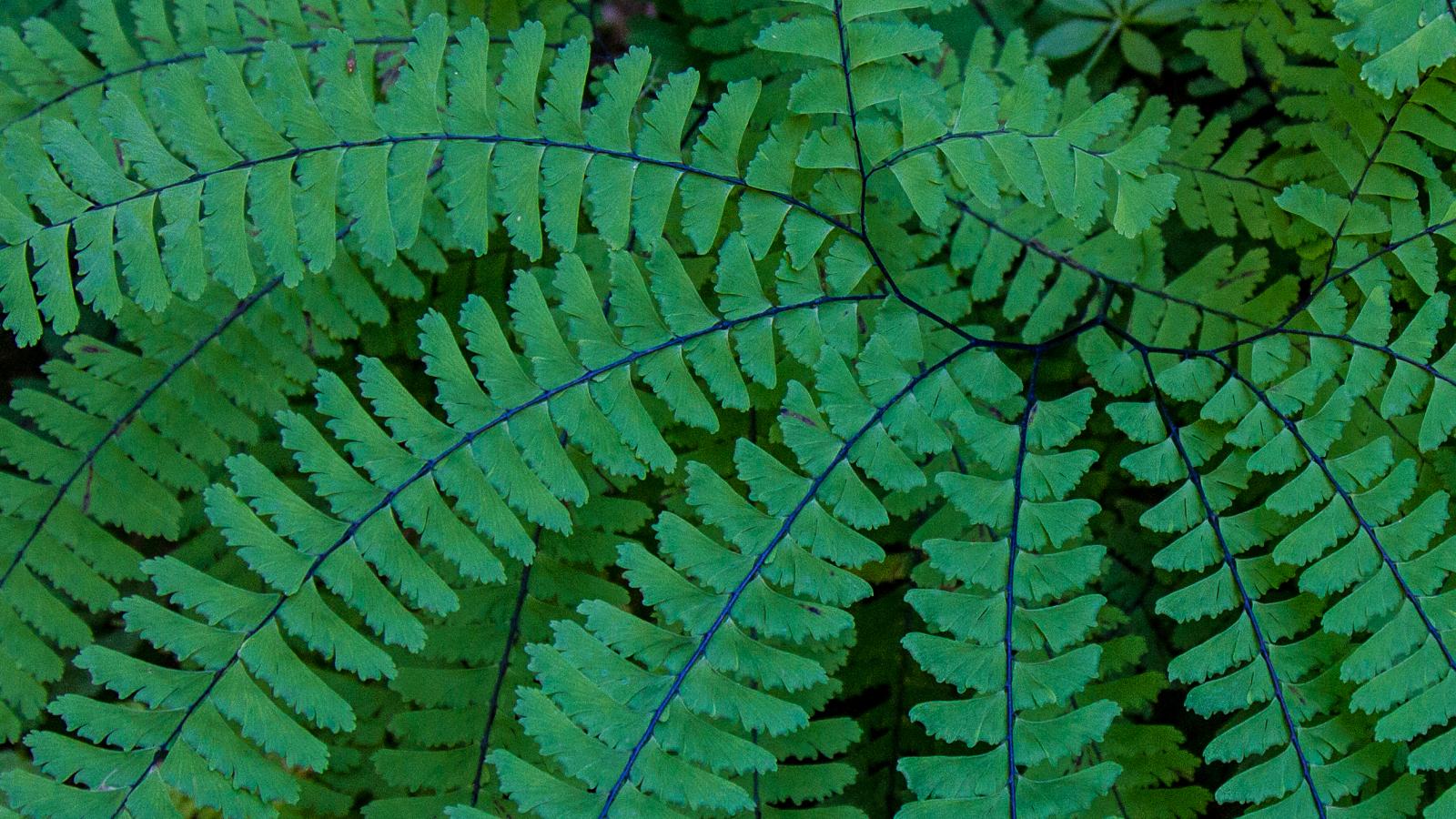
Wintertime Nature Connection with Ferns
Published December 4, 2025
Spring presents a colorful wildflower palette. Summer allows for long sunlit days for exploration. Fall offers a change of leaves and remarkable shadows. And winter? The rainy season gives a green gateway into connecting with nature through ferns.
Like emerald-colored lace, these primitive plants soften the understory beneath the canopy of shrubs and trees, creating habitat while transforming the landscape into a fairy realm. Any fan of Return of the Jedi is familiar with ferns. Local hikers will be, too: Calflora, a database of the state’s wild plants, lists 44 species documented in San Mateo and Santa Clara counties.
Though delicate in form, paying close, intentional attention to these feathery plants opens a portal into the profound. As Santa Cruz-based writer Sarah Juniper Rabkin proposes, “Fern-gazing is a glimpse into universal, elemental life processes that link human beings with every other organism on the planet.” Several species grow in nearly all Midpen preserves, providing fern-gazing opportunities galore.
Part of this human-fern connection is about survival. Their tender growth with the first rains is a symbolic sigh of relief after the six months of drought characterizing coastal California’s climate. The tightly furled new leaves, also called fronds, are called fiddleheads, named after the spiral shape of the top of violin and resembling a human baby’s tiny fist.
Ferns belong to an ancient lineage, greening up the earth about 200 million years before the dinosaurs dominated. On an evolutionary timeline, they arrived after the mosses, giving them a cutting edge with better developed roots, stems and leaves and a hardier system for moving water from soil to atmosphere. Yet unlike cone-bearing trees or showy flowers with their diverse pollination tricks that evolved millions of years later, ferns lack seeds. Instead, they have microscopic spores dependent on water to disperse.
Flip over a frond: the dots lining the leaflets or visible along the edges are called sori, the structures in which the reproductive spores are made. Though often mistaken for a plant disease, sori contain the ferns of the future.
Zooming back from the ancient past to the present challenge—human-caused climate change—part of this connection is happening through scientific study.
Since 2015, Midpen’s Interpretation and Education Department has teamed up with Save the Redwoods League and local high school students to gather data to learn how different species in redwood forests, including ferns, respond to rising global temperatures. Their efforts combine community science and fern-gazing to discover answers about adaptation and survival for future generations.
Finding Ferns
Where can ferns be found this winter? Good places to start include:
• The Wildcat Loop Trail in Rancho San Antonio Preserve for coastal woodfern (Dryopteris arguta), California maidenhair fern (Adiantum jordanii) and goldback fern (Pentagramma triangularis)
• El Corte de Madera Creek Preserve for western sword fern (Polystichum munitum) and giant chain fern (Woodwardia fimbriata)
• The Zinfandel Trail in Picchetti Ranch Preserve for coffee fern (Pellaea andromedifolia)
Search iNaturalist on each preserve’s homepage to see more fern hotspots. Happy fern-ing!