
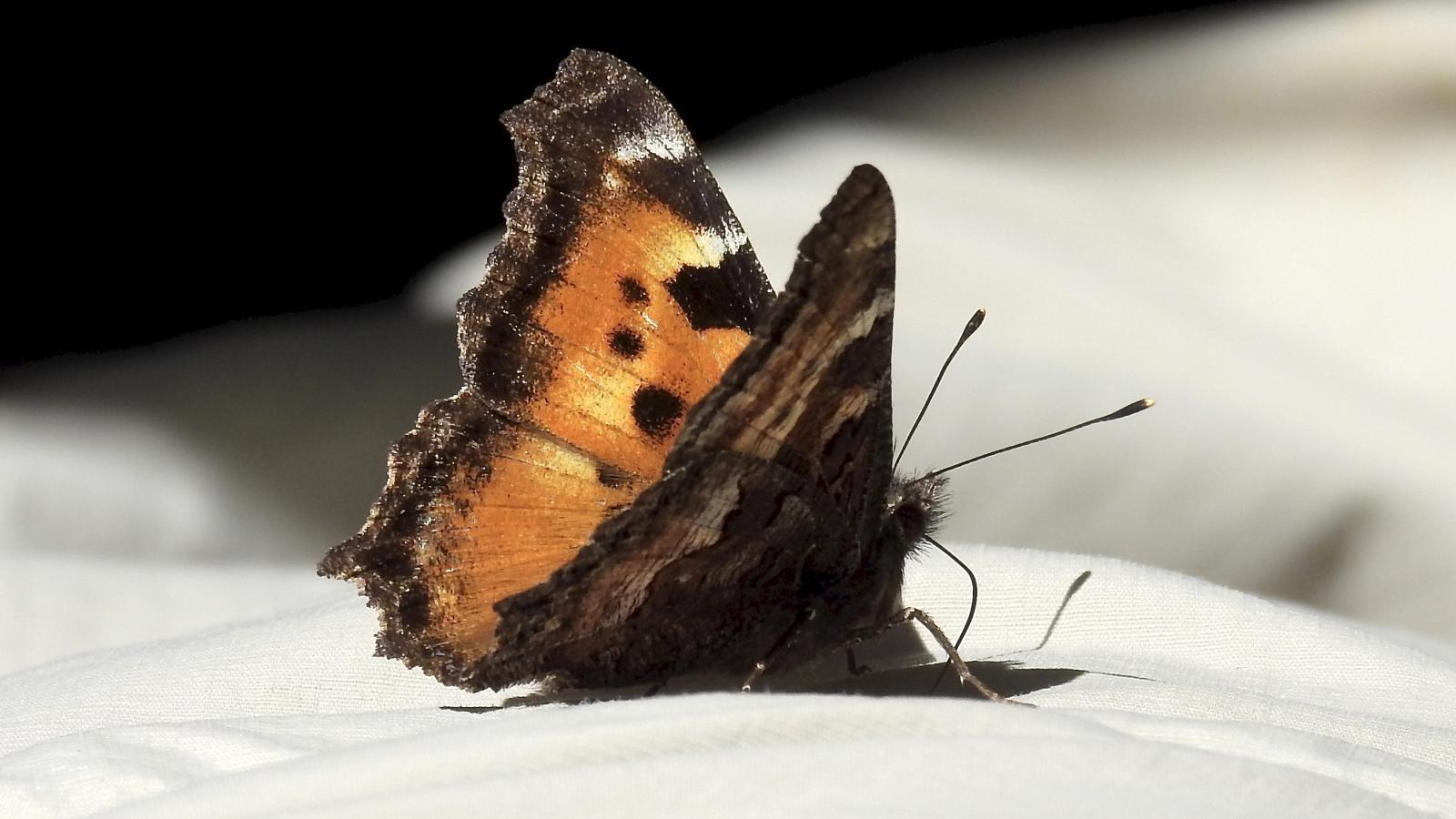
The Santa Cruz Mountains and Beyond Experienced an ‘Irruption’ of California Tortoiseshell Butterflies
Published May 22, 2026
You may have noticed while out on the trails, in your own backyard or even driving around in your car that there have recently been butterflies everywhere. Specifically, the brilliant orange and black California tortoiseshell butterfly (Nymphalis californica).
Last fall, the parents of these butterflies migrated in relatively large numbers from inland to coastal areas to overwinter in the mild climate. They laid eggs earlier this spring which hatched into caterpillars that feed on California lilacs (Ceanothus sp.), a common shrub throughout the state that has also grown substantially in the Santa Cruz Mountains areas burned by the 2020 CZU lightning complex fire.
“Conditions apparently allowed for high survival to adulthood, hence the irruption of butterflies,” said Dr. Stuart Weiss of Creekside Science.
Irruption is an ecological term relating to a sharp increase in a natural population, such as the mass migration of butterflies and other insects. California tortoiseshell butterflies are know for periodic mass migrations, including one in the 1970s that temporarily closed Interstate 80 over Donner Summit.
“Many will fly east to repopulate the inner Coast Ranges and the Sierra Nevada Mountains, and a few generations later, butterflies will migrate back to the coast this fall,” Weiss said.
The butterflies are being seen in many other areas and may be statewide phenomenon. While the sightings of dozens of butterflies at once seem to be fading, the children of these California tortoiseshell butterflies we see around us today will migrate back to the coastal areas of California in the fall to begin the cycle again.