
A Message From the General Manager: Celebrating Five Years
Published June 4, 2026
It takes a village to tend the living, changing landscapes that make up the Santa Cruz Mountains. That village has been showing up with boots laced tight and tools in hand—under bright skies, rainy days and everything in between—to help shape a more fire-resilient future for our open spaces and the communities that rely on them. Five years have passed since the inception of Midpen’s Wildland Fire Resiliency Program that enabled us to expand upon the work we already do to prepare for and prevent wildland fire and help increase the ecoystem’s resilience to it.
Looking back, I am awestruck at the progress we have been able to make in that time and appreciate the many staff involved in making it happen. The complexity of this work is considerable. Projects must be carefully prioritized to make the best use of limited resources and carried out with sensitivity to the natural environment by ensuring native plants, wildlife and habitats are protected and enhanced. The work itself is hard and often involves handwork, operating large equipment and managing steep slopes and difficult access.
In addition to ongoing year-round work that includes annual trail-brushing and mowing and fuel break maintenance, the Wildland Fire Resiliency Program has allowed Midpen to treat an additional 1,044 acres since its inception and reintroduce pile-burning and prescribed burning to our land-management toolbox. Each site we treat must be maintained in perpetuity moving forward and so as our fire program matures, the annual work plan is now nearly an even mix of maintaining existing fuel breaks and creating new ones.
To get to this point, the necessary resources and capacity had to be built through additional funding, staff, contractors and collaborative partners.
Leveraging Funding
Several large grants have helped launch Midpen’s expanded fire program. These include a total of $2.58 million in grants from the California State Coastal Conservancy and the Wildlife Conservation Board that supported capacity-building, forest health work, equipment purchases and prescribed fire work. In addition, Midpen is a partner in the Los Gatos Watershed Collaborative led by the Santa Clara County FireSafe Council and has received more than $3.3 million in grant funding from CAL FIRE for forest health projects, resulting in 690 acres of Midpen preserves in the South Bay area being treated to date, with more work ongoing.
Building Capacity
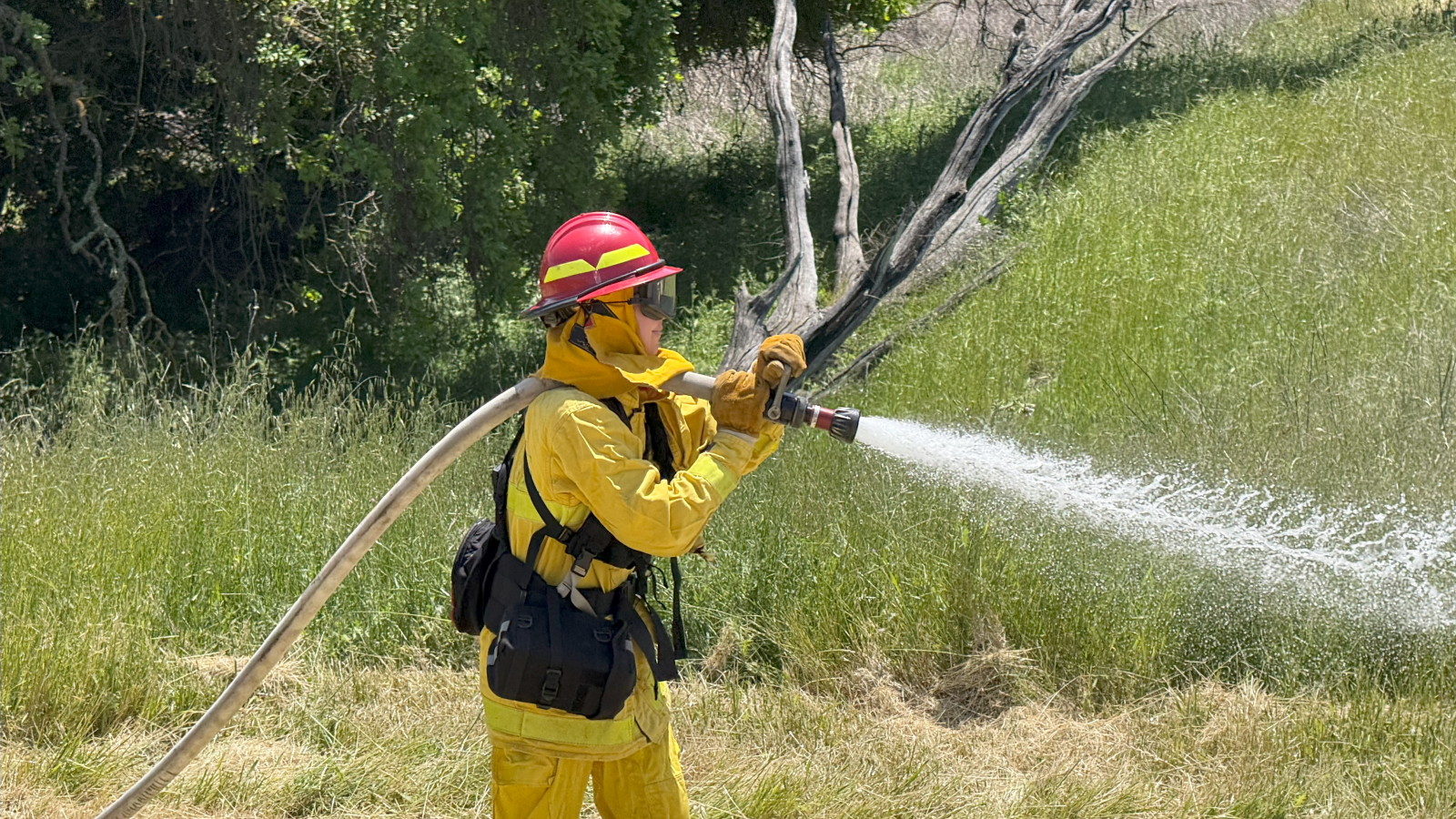
Financial resources are only helpful if we have the staff and equipment to physically carry out the vegetation management projects on the ground. Early on in the fire program, we relied more on contractors. Today, we are able to complete large vegetation management projects primarily in-house, having staffed two field resource crews at our Skyline-area and Foothills-area offices. These crews include a Field Resource Specialist, a Lead Open Space Technician (OST), two OSTs and an Equipment Mechanic Operator. Establishing and growing partnerships with local conservation corps and contractors helps to augment the work Midpen staff can accomplish.
A shaded fuel break across 50 acres in Coal Creek Preserve was one of the first projects completed in 2021 under the expanded fire program, and the San Jose Conservation Corps and Charter School along with a Proposition 68 grant helped make it possible. Midpen crews have already returned once to maintain this site.
New equipment purchased with grant funding is being put to good use, including two remote-controlled mowing machines that can navigate steep slopes, a chipper and an excavator.
Partnerships
Fire does not stop at property boundaries, so working with other partners in the area to prioritize and collaborate has been critical to implementing landscape-level projects that are more effective. For example, Midpen partnered with the City of Palo Alto and the Santa Clara County FireSafe Council on an emergency escape route project along Page Mill Road that spanned four Midpen preserves and resulted in about 50 acres being treated on Midpen land within 150 feet of the roadway.
Though fires rarely start in Midpen preserves, fire is a fact of life in California. A changing climate, a local history of intense logging resulting in dense forest regrowth coupled with more than a century of fire suppression are just some factors contributing to a longer, more intense fire season. Midpen’s Wildland Fire Resiliency program is aimed at helping Midpen meet these new challenges proactively.