
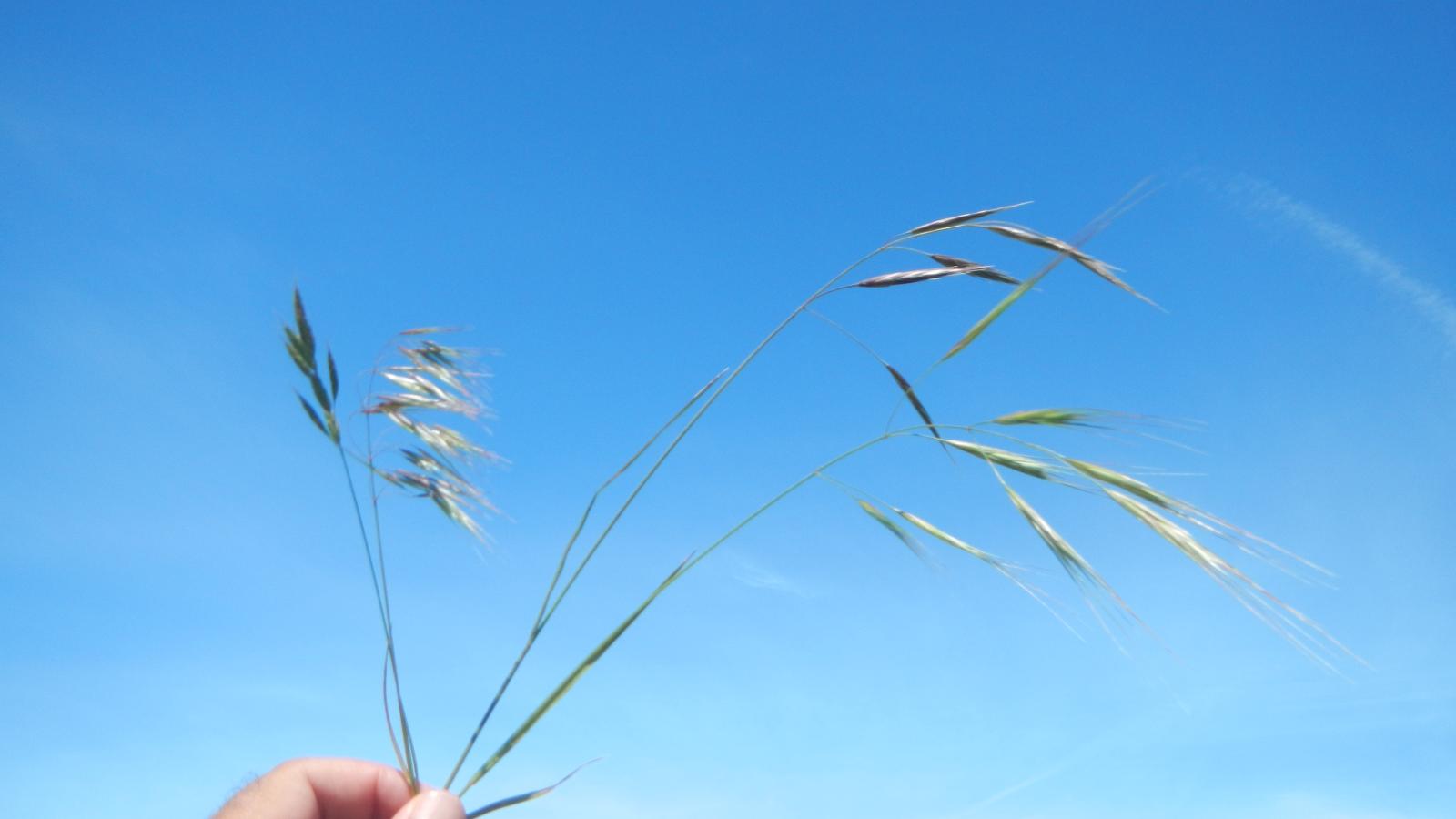
How Early Detection Helps Keep Cheatgrass in Check
Published August 6, 2026
Protecting thousands of acres of open space can begin with someone noticing a single plant. In 2021, during routine vegetation monitoring at a Midpen preserve, Midpen rangeland ecologist and botanist Lewis Reed spotted something unusual.
“I looked into the grassland and thought ‘Oh my gosh, that looks like cheatgrass,’” Reed recalled.
To most people, cheatgrass (Bromus tectorum) looks much like any other grass, but Reed recognized it immediately as an invasive species with the potential to become a serious ecological threat if left unchecked. Across much of the American West, cheatgrass has earned a reputation as one of the region’s more troublesome invasive plants, altering ecosystems and changing how wildland fire behaves. The patch Reed found was small, fewer than 100 plants, but he knew it required immediate attention. He removed every plant he could find and marked the location to monitor again the following year.
This discovery illustrates one of Midpen’s most important, but least visible land management tools: routine ecological monitoring. Reed and other Midpen scientists regularly survey preserves to detect anything out of the ordinary that may pose a threat to the area’s ecology before it becomes a landscape-level challenge. This strategy is called Early Detection, Rapid Response, or EDRR. The approach focuses on identifying and removing invasive species when populations are still small, before they become more widespread and more expensive and difficult to control. When Reed returned to the cheatgrass site in 2022, he quickly realized that this problem had grown.
“I thought I’d just be pulling a few plants,” he said. “Then I got there and realized ‘oh no, we have a situation.’”
Cheatgrass can spread quickly, because it germinates during the wet season, grows rapidly and produces many seeds. It can outcompete native vegetation, because it dries out earlier in the season than many native grasses, it leaves behind a dense layer of dry vegetation that further crowds out native species, changes wildlife habitat and creates highly flammable fuel. Although the coastal grasslands already contain many nonnative annual grasses, cheatgrass remains relatively uncommon along the San Mateo County coast. That made early detection especially valuable.
“When something is new to our region, that is significant, especially if we know that it has been problematic elsewhere,” said Reed. “We want to get on it before it becomes a problem.”
To slow the spread, Midpen staff and contractors developed a management strategy tailored to cheatgrass biology and the conditions at the site. Crews used timed mowing to cut the plants after they had invested most of their energy into flowering, but before their seeds could mature and drop. The site also contains a population of the rare Chloris's popcornflower (Plagiobothrys chorisianus var. chorisianus), requiring careful work around sensitive habitat. Rather than mowing, crews gently hand-pulled cheatgrass near these rare plants. By spring 2025, the once-dense patch had been reduced to scattered individual plants.
“You then have to find the hay in the haystack – literally,” Reed said. At that stage, the work shifted from broad treatments to meticulous surveys. Crews painstakingly combed the grasslands, removing every individual they could find.
This year, Reed found fewer than 30 individual plants. After they were removed, follow-up surveys found no additional cheatgrass at the site.
Midpen is applying the same EDRR approach to another cheatgrass occurrence at Windy Hill Open Space Preserve. Dedicated Midpen staff have successfully contained this second occurrence through repeated hand-pulling treatments. While Reed says continued monitoring is required, he is encouraged by the progress.
“We’re not ready to say it’s gone,” he said. “But I’m really happy with where we are right now.”
Visitors can also help prevent cheatgrass and other invasive species from spreading. Cheatgrass seeds cling easily to socks, shoelaces, backpacks, pet and wildlife fur and tires, allowing them to travel. Before and after heading out on the trail, take a moment to brush seeds and plant material from clothing, gear and pets. Those simple actions, combined with ongoing ecological monitoring, will help protect the Bay Area’s native species for years to come.
Learn more about Midpen's Integrated Pest Management Program at openspace.org/IPM.